By Audra Verona Lambert
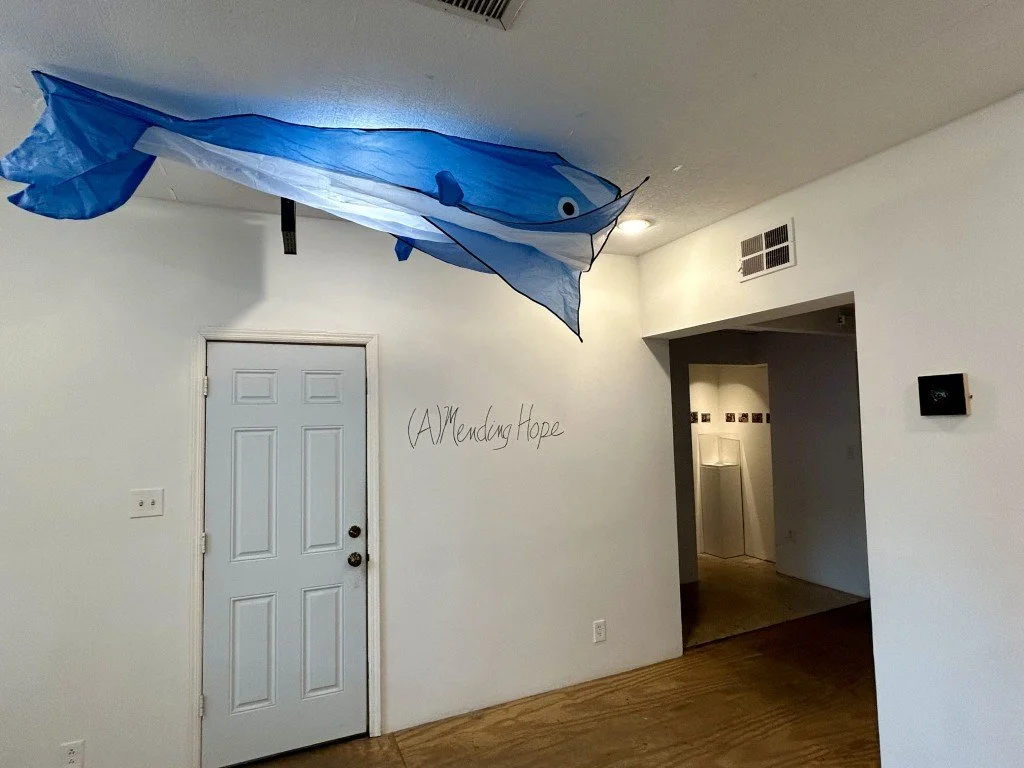
Amending Hope installation shot
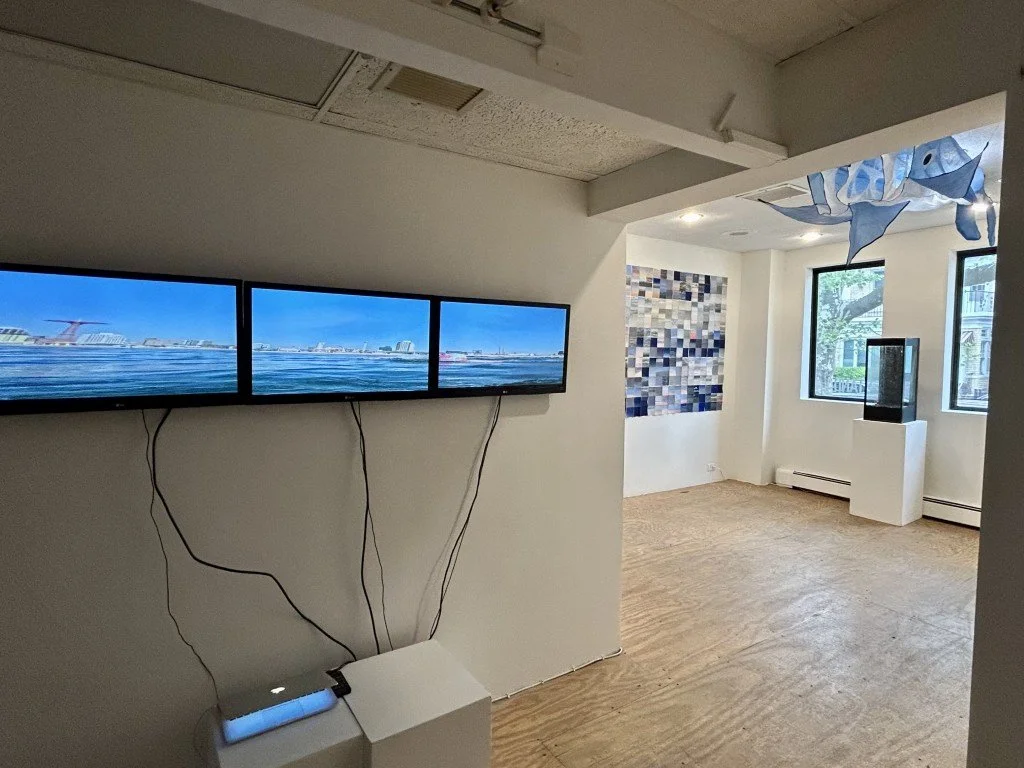
To converse with Jeannine Bardo is to understand that multiple threads connecting the world around you are slowly, effortlessly enveloping you within its web at her behest. The different dimensions collide so slowly that you’re not aware that these disparate arenas are enveloping you, and once they grab you, it’s too late to evade capture. “My brain is always making connections,” Jeannine reflects. “Opening my practice up to collaboration nurtures that part of me.” Guiding me through the most recent solo presentation of work on view in her Stand4 gallery space located in Bay Ridge, Brooklyn, ‘(A)mending Hope,’ it is clear the artist embraces the idea of hope as a beacon speculating on the capacity to build positive, community-driven futures. Seamlessly transitioning from the light-filled, street-facing front gallery toward video work(s) in the darkened back gallery, Jeannine showcased a range of artistic processes through this robust but deliberate exhibit. Artwork is visible in literally every direction except down: Cetus, a ceiling-mounted whale-kite in the front gallery pairs symbiotically with the artist’s Dawns: a wall-mount installation work consisting of tiny painted views of sunrise, sewn together, that were taken daily starting 2024 along the artist’s morning walks in her Bay Ridge, Brooklyn neighborhood. This compilation– a durational vision celebrating locality–builds a record of the South Brooklyn sunrise day after day by measuring the slow, steady march of time in the artist’s environs.
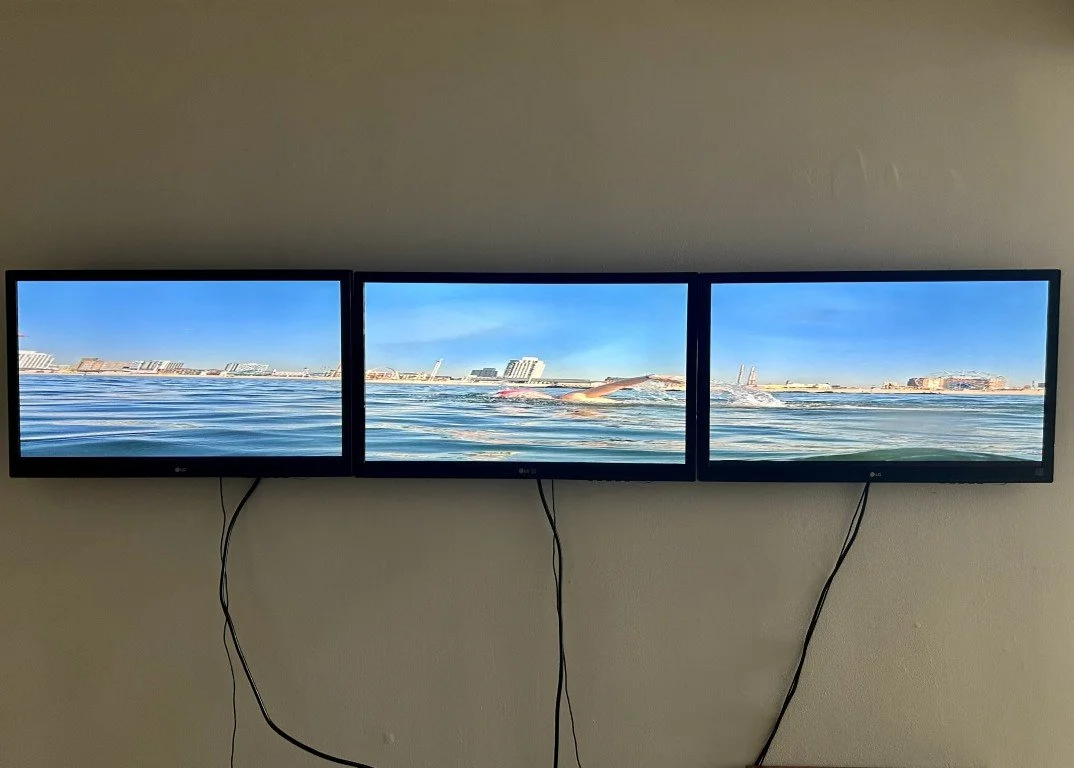
Amending Hope, Anam Cara
Moving into the interior area of the gallery, one encounters Anam Cara: a three-channel video work featuring the artist’s swim companion, Cara, repeatedly plunging into the waters off of Coney Island. In the video work, Cara continues past the shoreline playground, carrying the landscape with her: stroke after stroke, second after second, she progresses parallel to the coastline beyond. Coney Island as site is a psychological as well as physical location: iconic, easily recognizable and for those of us who have visited, enmeshed with our own memories of Luna Park and Coney Island: the parachute drop, Deno’s wonder wheel. In this exhibit, as well as in her practice more generally, the artist frequently embraces inquiry into site via artistic collaborations. This is shown across the space, from mail art to kinetic sculpture, as Jeannine faithfully presents works that embrace her penchant for natural observation and joins with others to realize the final artistic form of each investigative effort. Jeannine organically investigates the natural world, transposed through the lens of her native New York City environs, as a palpable springboard from which to expand her artistic practice.
Amending hope, installation shot
In the exhibit ‘(A)mending Hope,’ as with her continued overlapping bodies of work exploring flora and fauna in the urban space, the artist syncretizes aspects of her surroundings into bodies of work that find their natural form through meticulous conceptual inquiry. “I feel the energy [of nature] – [it] sometimes feels like a conversation,” she reflects. “I believe living beings have their own consciousness.” Jeanine’s ability to take parts of the existing universe and transform them through her practice in ways that envelope multiple strands of meaning approaches the transcendental. Her fearless manner of digesting multiple concepts, mediums and processes, often through partnerships with other artists and cultural producers, creates new avenues of discovery effortlessly uniting distinct, geographically overlapping communities.
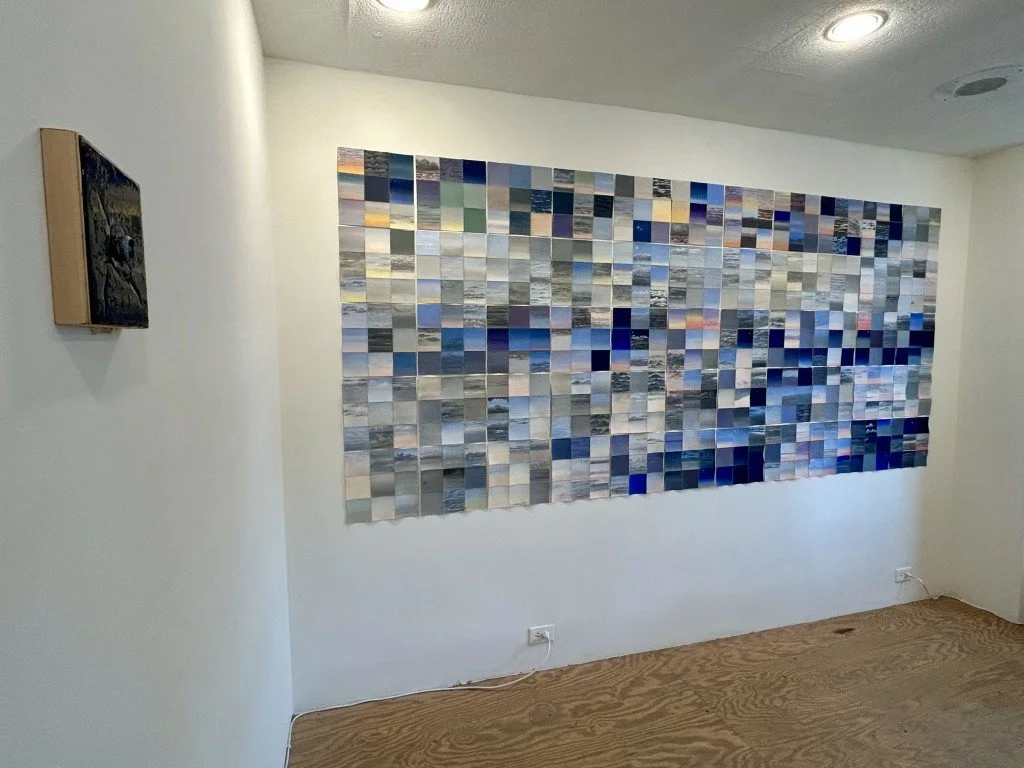
Amending hope, installation shot
A multi-disciplinary artist, Jeannine shifts between the differing approaches embedded in her creative practice with ease. An artist-educator-curator-community art space founder (and the tireless force behind community-focused Stand4 Gallery,) the one thing Jeannine doesn’t do is hold back. She creates formidable work in her personal practice while effortlessly forming collaborations with artists working within her community. She continues to commune with curator Jennifer McGregor to co-present a Bay Ridge-based, community-forward art biennial. She engages curious local residents with nature by utilizing an artistic lens, meeting them at their own distinct cultural perspectives. The one clear thread forming a throughline that connects these avenues of her practice as a cultural producer is storytelling. “Storytelling comes in different forms throughout my work,” Jeannine observes. “Sometimes I include poetry to accompany the objects; sometimes I create a speculative future or question our systems, collaborat[ing] with the viewers to imagine new ones. Other times, I just let the objects tell [their own] stories: stories of trauma, hope, honor, mourning…stories [reflecting] the human condition and our place in the world.”
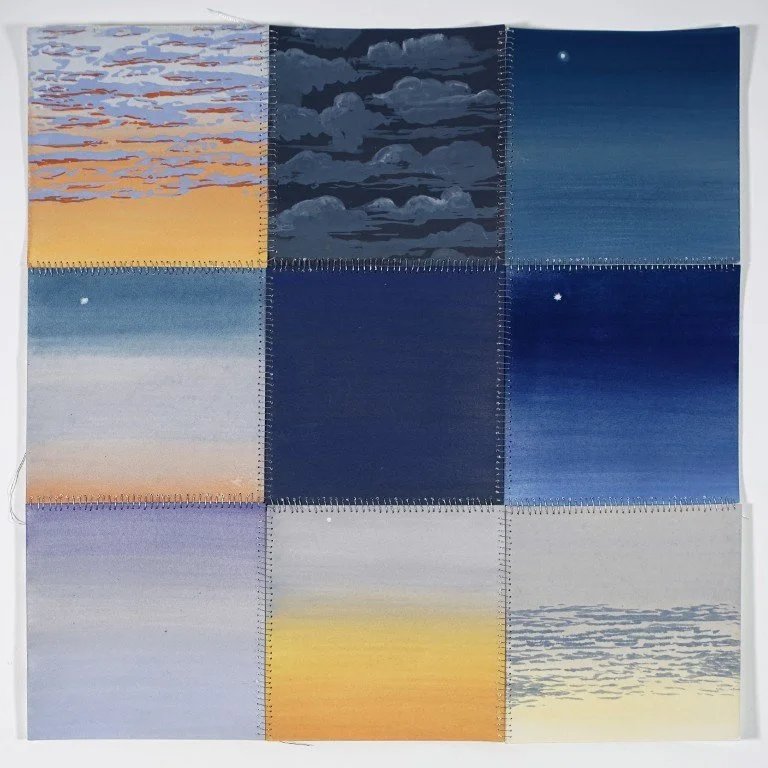
Dawns No 1
Two significant bodies of work by the artist are worth mentioning in greater detail. Since 2024, the artist has worked to create her Dawns series of durational paintings as well as the ongoing Brooklyn Arts Council-funded public art project, The Learning Ring/A Tree’s Standing. While the two series present divergent viewpoints, each is satisfyingly rooted in observation, ritual and resilience. With Dawns, the artist produces miniatures that capture quiet moments at dawn, day after day, as she traverses Bay Ridge. Jeannine presents a meticulously curated view of the sky, working from her block —looking up Southeast — on daily morning dog walks. Cloudy mornings, bright mornings, rainy mornings: each and every distinct sunrise – colored by the atmospheric light of the nearby Atlantic Ocean – is painted in a blend of diffuse color washes and detailed brushstrokes. Clouds are rendered in exacting form in the artist’s Dawns No. 01, their height in the sky perceptible even within the framework of these minuscule paintings. Dawns No. 15, in contrast, clearly depicts another season: gray ridges of clouds appear almost like waves breaking against a shoreline on a calm day. Hues of gray and blue intersperse throughout this suite of 9 landscapes, sewn together – like all works in this series– with clearly visible silver threads. The artist makes these threads an obvious facet of the work: straight stitches linking one morning to the next, connecting the artist’s own daily routine to the finished works. Honest and unassuming, Dawns is artful in its straightforward approach, serving as a record of time that resonates with city dwellers who look up, welcoming the delight and promise of a new day despite the din and chaos of the urban landscape below.
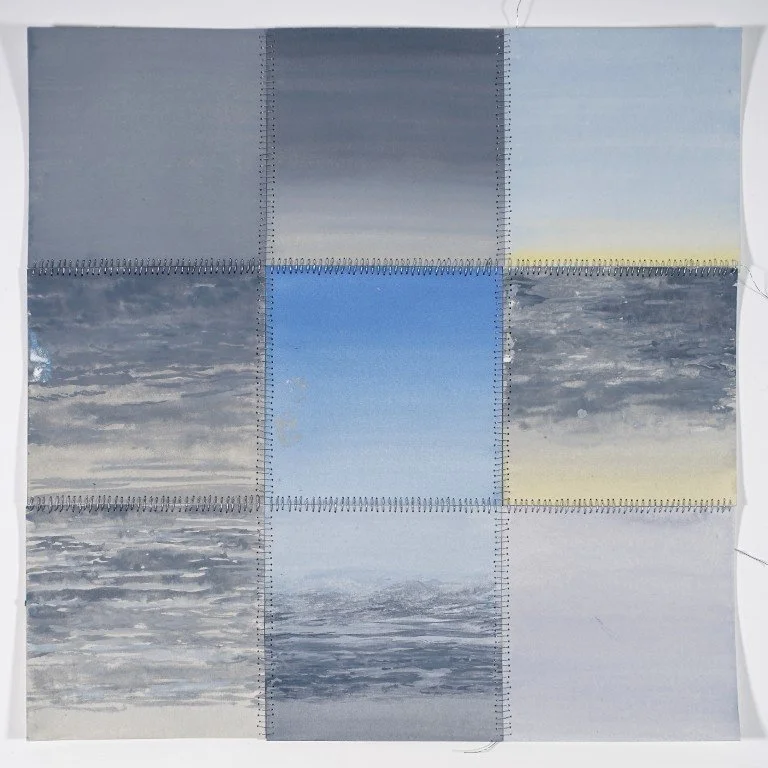
Dawns No 15
Where the artist records time in her Dawns series, she brings the passage of time as recorded through tree growth to audiences in Bay Ridge with her project, The Learning Ring/A Tree’s Standing. Now in its second phase and envisioned with community collaborators in mind — including historian Henry Stewart and the team behind Marcela Cocina Mexicana, among others — Jeannine approaches the community’s much-loved McKinley Park through the lens of some of its longest-lived residents: its trees. Embracing the legacy of the sweeping treeline as artwork while investigating the park as a treasured space for recounting collective and individual memories, Bardo is continuing this project with support from the Brooklyn Arts Council, uniting the changing diasporas residing near the park in the concrete experience of walking through trees in this century-old public park. Despite language and cultural barriers, the artist strives to build new bridges and to adopt the language of Milton in Paradise Lost, to join in (new) connections sweet, gathering together residents reflecting the changing social fabric of Bay Ridge living along the park’s periphery. Discussing The Learning Ring/A Tree’s Standing in greater detail, Jeannine stresses the importance of guiding a range of visitors–with knowledgeable guest historian/scientist collaborators–to explore the natural world. She observes the importance of leaving room for personal encounters led by creative interpretation when approaching the awe of the natural world embedded in the urban landscape. “[Nature in the urban environment] makes me appreciate life’s resilience,” she reflects. “I find that hopeful. Life is everywhere.”
Audra Lambert (b. 1987, New Orleans) is an independent curator and art critic based in New York City and Editor-in-Chief of ANTE. mag, a platform for under-the-radar contemporary arts + culture. Lambert is Founder/Chief Curator of Antecedent Projects(2014), a NYC- based curatorial consultancy focused on site-specific projects. Her current curatorial project, "Hey, Wow: Works by Oded Halahmy", is on view at the Yeshiva University Museumthrough December 2018. Lambert has curated exhibits with the White Roof Project(2015), Flux Art Fair (2016) and New York City Parks Dept's Arsenal Gallery (2017). Lambert currently serves as Curatorial Manager for Art in Odd Places 2018: BODY. She has served on jury and portfolio review committees for RISD, Sugar Hill Children's Museum, Orangenius, and more. She has served as a curatorial portfolio reviewer at RISD, Hunter College (CUNY) MFA Program, NARS, Kunstraum LLC, and Residency Unlimited.