by Hayley Ferber
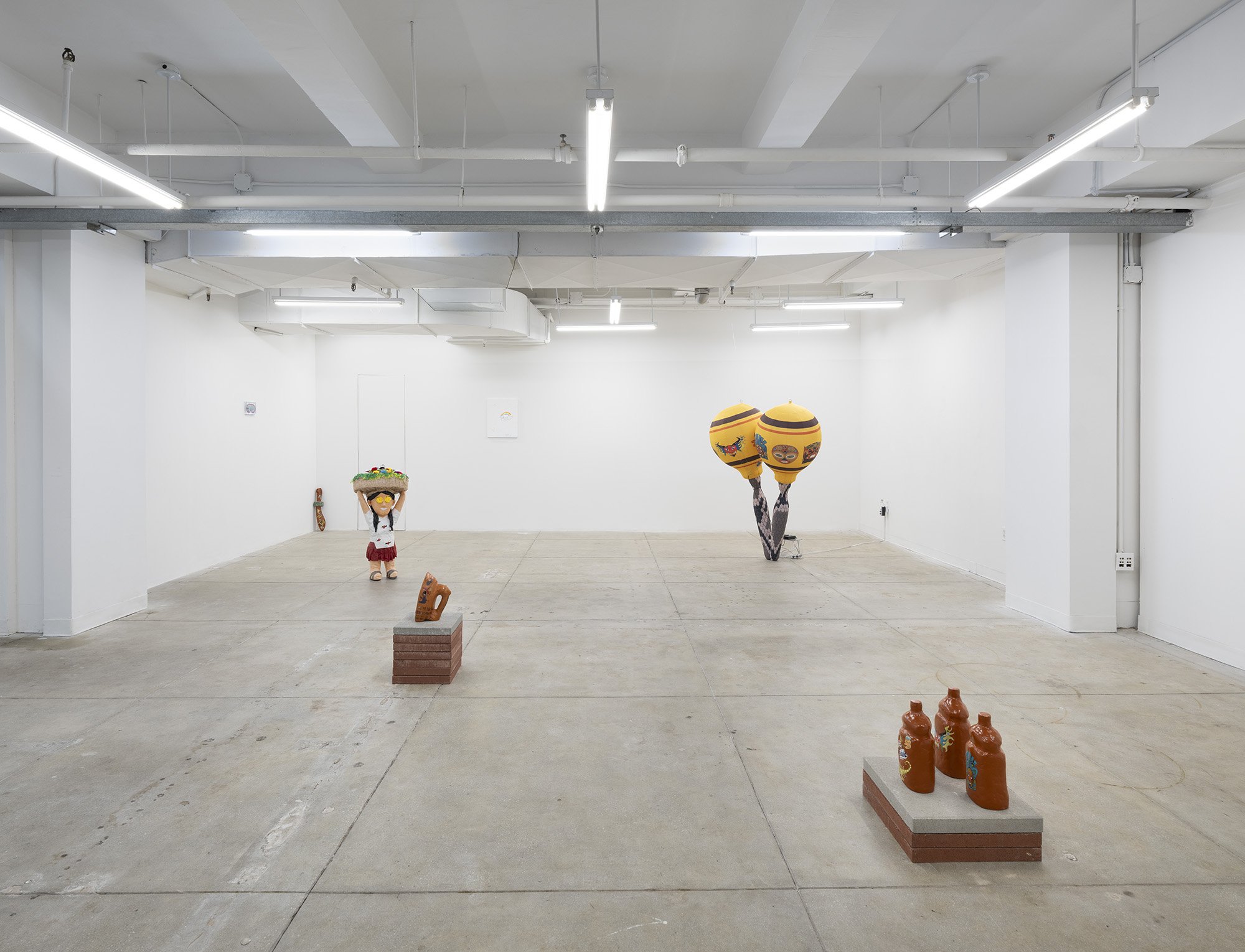
Installation view, Jamie Martinez: Fabuloso at MAMA Projects, NYC, 2026. Image courtesy of MAMA Projects. Photo by Adam Reich.
For Jamie Martinez, an object is never simply an object. It can be a vessel, a witness, a container of memory, a record of labor, or a site where histories collide. Working across painting, sculpture, installation, and performance, the Colombian-born, New York-based interdisciplinary artist approaches each body of work as an unfolding investigation—one that begins with research but is ultimately guided by intuition, spiritual inquiry, and a willingness to listen to what the work itself is asking to become.
Born in Ibagué, Colombia, Martinez draws from the histories, spiritual traditions, and ancient beliefs that have shaped his understanding of the world. His practice frequently moves between the personal and the collective, the contemporary and the ancestral, and the physical and metaphysical. Indigenous spirituality, colonialism, migration, labor, ritual, and ceremonial gathering recur throughout his work, but Martinez does not treat these subjects as fixed themes. Instead, they become points of departure for processes of excavation and transformation.

Jamie Martinez, Fabuloso concentrate 2X Ocean Cool Scent 1, 2026, oil stick, oil pastels, oil pencils, acrylic paint on wood board, 8 x 10 inches. Image courtesy of MAMA Projects. Photo by Adam Reich.
His work does not adhere to a singular visual language or predetermined methodology. Instead, the concept determines the form. Materials, processes, and scale shift according to what each project requires. Organic materials may evoke indigenous craftsmanship or physical labor; machines can become performers with their own emotional presence; books can be sealed and transformed to suggest altered narratives; ephemeral objects such as piñatas can become vessels for mystery, celebration, confinement, and loss.
This responsiveness is central to understanding Martinez’s practice. He does not impose an idea upon a material so much as enter into a relationship with it. In the studio, he listens to the work. The process becomes a negotiation between intention and discovery, between what he brings to an object and what the object reveals in return.
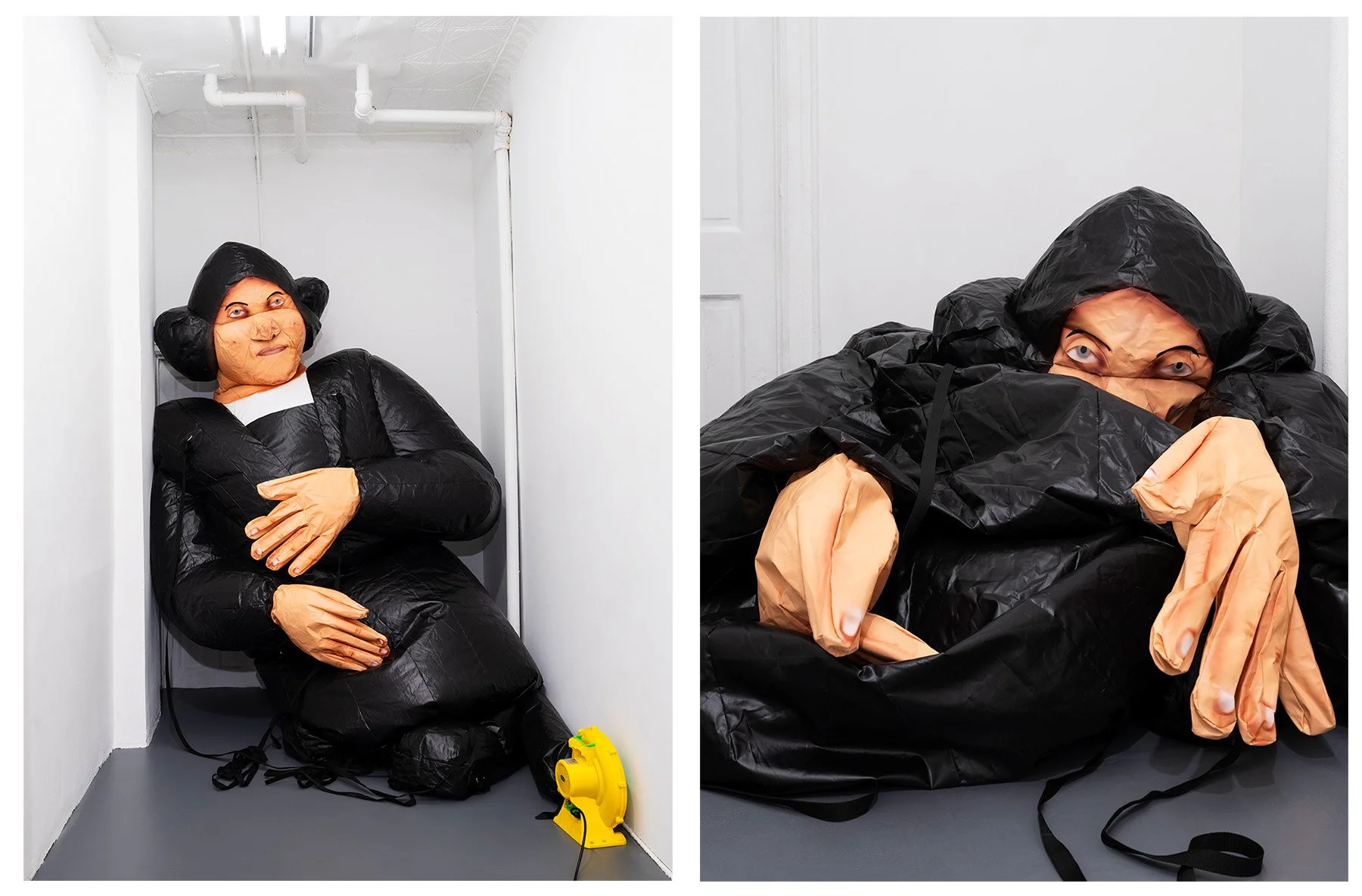
Jamie Martinez, The Rise and Fall of Christopher Columbus, 2024, vinyl, thread, acrylic paint, timer/remote control, and air blower, H 15 feet x W 9 feet x D 7.5 feet. Image courtesy of GHOSTMACHINE Gallery and the artist.
This sense of listening extends to his treatment of history. Martinez is deeply interested in the fragmented narratives produced by colonialism: what has been erased, who has been allowed to speak, and how histories can be reconstructed when their original forms have been disrupted. His works often enact this process physically. Objects are dismantled, reassembled, sealed, confined, transformed, or made to perform. Rather than attempting to restore an imagined original state, Martinez embraces fragmentation as a condition through which new narratives can emerge.
Sealing is particularly significant within this vocabulary. Through polyurethane and other processes, Martinez encases objects, trapping movement and energy while simultaneously preserving traces of what lies within. To seal something is to protect it, but it can also be to confine it. This tension between preservation and imprisonment becomes a metaphor for the ways histories are carried forward. What happens when a story is sealed? What remains visible? What becomes inaccessible? And what happens when the seal is finally broken?
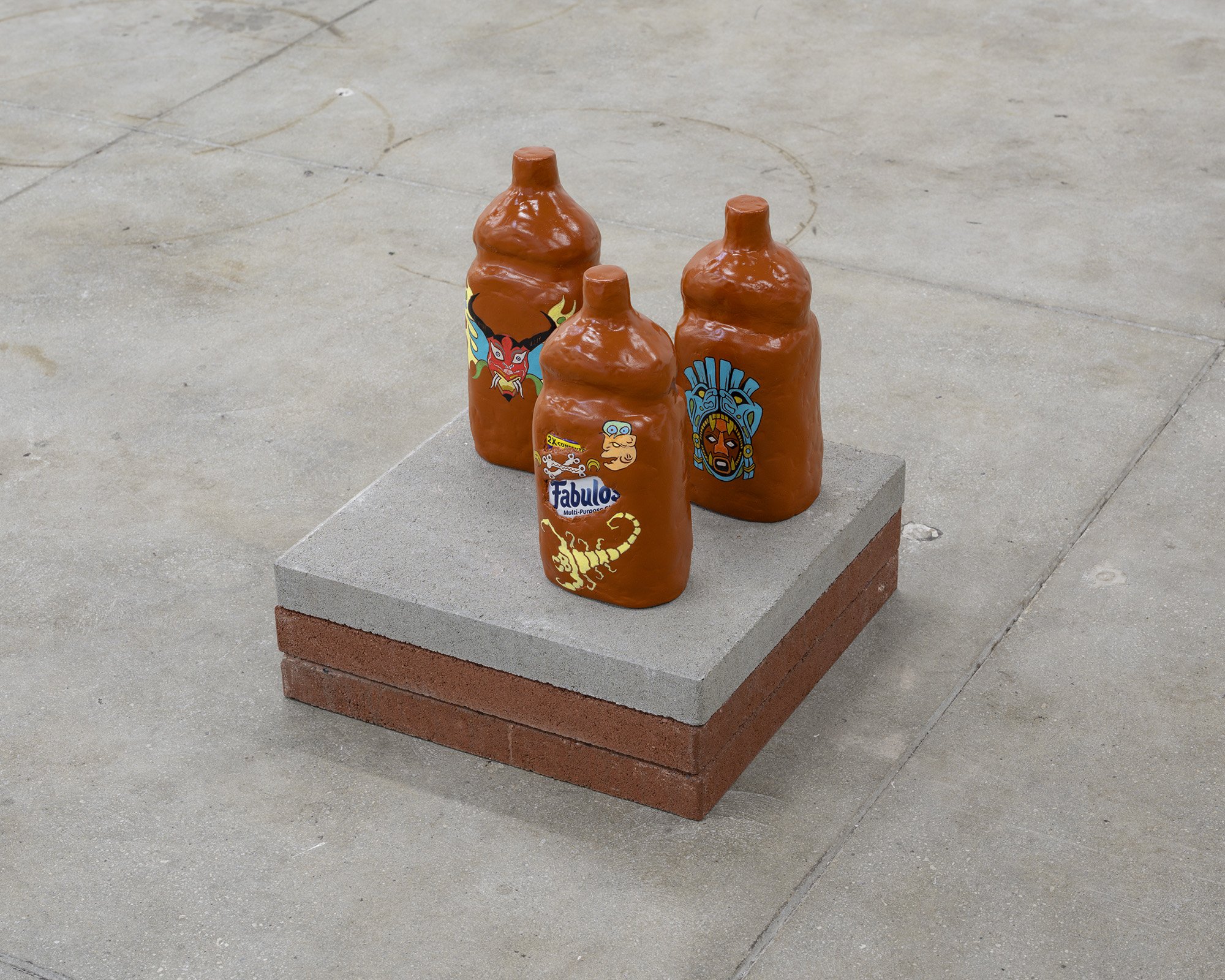
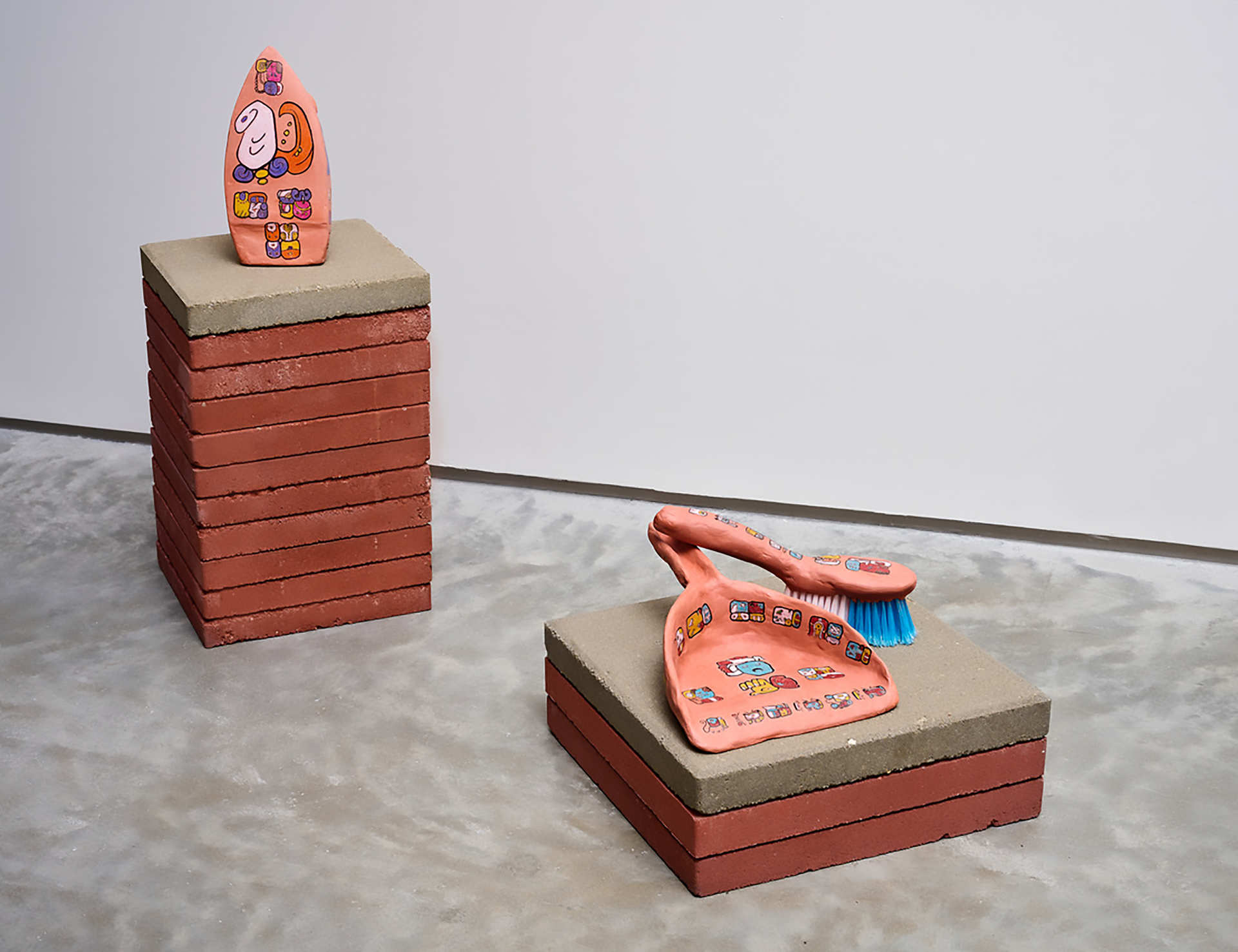
Jamie Martinez, Fabuloso Sweat, 2026, Lavender Fabuloso and synthetic sweat sealed in clay. The products were used to clean 11th Avenue between 50th and 51st Streets in New York City, 10.5 x 4.5 x 3.5 inches (each). Image courtesy of MAMA Projects. Photo by Adam Reich.
These questions are particularly resonant in Martinez’s explorations of immigration and labor. His experience as a Colombian artist living and working in the United States informs a broader interest in the dignity, difficulty, and visibility of work. Labor in his practice is both physical and political. It is the labor of making, migrating, surviving, cleaning, building, and sustaining communities. It is also the labor involved in carrying identity across borders.
His project Fabuloso, for example, draws on the ubiquitous cleaning product and the cultural associations embedded within it. Cleaning becomes both literal and metaphorical: an act of maintaining dignity in circumstances that may otherwise deny it. Martinez’s phrase, “When you are down, at least things are clean,” captures the complicated pride contained within this gesture. Cleaning a street, a home, or an object can become an assertion of presence—a declaration that even under difficult circumstances, one can create order, beauty, and care.
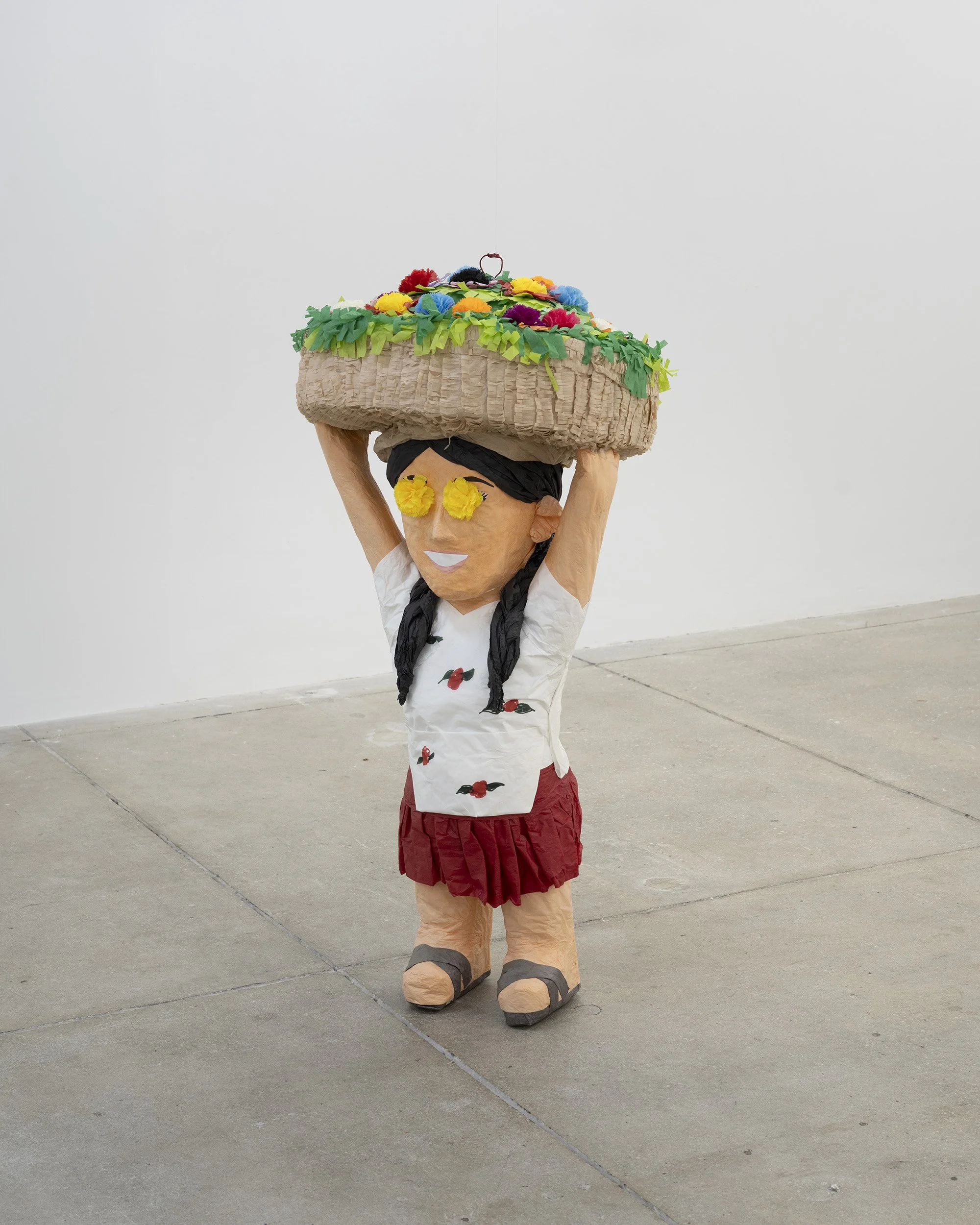
Jamie Martinez, The Flower Lady Piñata, 2024-2026, paper-mache, cardboard, acrylic paint, synthetic flowers, glue, ribbon, stuffed with mystery gifts inside, 38 x 14 x 9 inches. Image courtesy of MAMA Projects. Photo by Adam Reich.
There is also humor and joy within Martinez’s engagement with labor and migration. His piñata-inspired works complicate the weight of his subject matter by introducing celebration, anticipation, and play. The piñata is simultaneously fragile and durable, beautiful and temporary, mysterious and destined to be broken open. Its concealed interior suggests hidden histories and trapped energy, while its communal destruction transforms an individual object into a shared experience. In Martinez’s hands, the piñata becomes an unexpectedly rich metaphor for identity, migration, and inherited narratives: something constructed, carried, protected, and eventually opened.
Machines occupy another important position within his practice. Martinez treats machines not simply as tools but as collaborators and performers. Through programmed or mechanical actions, they breathe, paint, repeat, and respond. In these works, technology takes on a strange emotional presence. A machine can become a portrait of labor; it can embody repetition, discipline, exhaustion, or desire. When a machine paints a machine, the distinction between maker and made, human and technological, begins to collapse.

Installation image, Jamie Martinez, My Mother’s Labor: The Machines at GHOSTMACHINE Gallery, New York. Image courtesy of GHOSTMACHINE Gallery and the artist.
This interest in animation and agency reflects Martinez’s larger commitment to honoring movement. Whether through performance, mechanical processes, ritual objects, or physical gestures, movement becomes a form of knowledge. Rather than freezing an experience into a static representation, Martinez attempts to capture its energy. His objects may be sealed, but they are rarely inert. They contain evidence of actions that have already occurred and suggest actions that might still take place.
His relationship to indigenous histories is similarly grounded in an interest in movement, ritual, and continuity. Drawing in part from the Pijao people of Colombia as well as motifs and traditions from multiple cultures, Martinez approaches spiritual and ceremonial forms with an awareness of their complexity. These references are not simply decorative quotations. They function as prompts for thinking about how knowledge travels, how rituals survive, and how belief can persist despite historical violence and cultural disruption.
Installation view of the group show “Invisible Hands” at 601 Artspace curated by Emireth Herrera Valdés, NYC, 2023. Image courtesy of 601 Artspace and the curator. Photo by Go Sugimoto.
This research-oriented approach extends into Martinez’s curatorial and community work. As Publisher and Editor of Artefuse Magazine, as well as through his involvement with community art activities and organizing under The Border Project Space, he occupies a position that moves fluidly between artist, curator, organizer, and researcher. Curating, for Martinez, is another way of listening. It allows him to step outside of the individual artwork and recognize larger connections—between practices, histories, communities, and ideas.
That expanded perspective is essential to his artistic practice. Martinez does not simply make objects; he creates situations in which objects can speak. He asks us to consider what they have witnessed, what they contain, what has been erased from them, and what energy remains. His studio becomes a laboratory for these questions, where painting, sculpture, performance, machines, organic materials, and found objects are brought together through an intuitive but deeply researched process.

Jamie Martinez, Jamie Martinez, The Big CON - Conquistador Voices Volume 1: The Spanish Conquest of the Americas as Recounted Largely by the Participants, author Kevin H. Siepel, 2024, purchased book covered with non-fired clay, acrylic paint, citrine raw crystals, glue, polyurethane, H 10 x W 7.5 x D 2.5 inches. Image courtesy of GHOSTMACHINE Gallery and the artist.
Ultimately, Martinez’s work asks us to reconsider where history resides. It may exist in a sealed book, a cleaning product, a piñata, a machine, a laboring body, or an inherited ritual. It may be buried within an object or revealed through its destruction. It may exist in the movement between countries, generations, cultures, or belief systems. Martinez’s practice does not attempt to provide definitive answers to these questions. Instead, it creates vessels for uncertainty, memory, and transformation. To encounter his work is therefore to be asked to slow down and listen—to the object, to the material, to the movement, and to the histories contained within them.
Hayley Ferber is a Brooklyn-based independent curator, educator, and artist with a professional mission to support a creative community of multidisciplinary artists. She has curated more than 20 exhibitions for institutions including Westbeth Gallery, BronxArtSpace, 440 Gallery, Residency Unlimited, All Street Gallery, Lichtundfire, Equity Gallery, and the Consulate General of Brazil in New York among others. Her writing has been published in Art Spiel, Art DIalogues and USA Art News. Hayley holds an MAT in Art & Design Education from RISD and a BS in Studio Art from NYU. www.hayleyferber.com